
Tablet Hardness Test Explained for Breaking Force and Quality Control
Tablet Hardness Test and Its Role in Pharmaceutical Quality
The tablet hardness test is one of the most important mechanical evaluations in pharmaceutical quality control. It determines whether a tablet has sufficient mechanical integrity to withstand manufacturing, packaging, transportation, and handling by patients. From high-speed coating lines to automated blister packaging, tablets experience repeated mechanical stresses. If hardness is not properly controlled, tablets may crack, chip, or break, leading to quality failures and potential regulatory risks.
In practice, the tablet hardness test focuses on measuring the breaking force required to fracture a tablet under controlled conditions. Although the term “hardness” is widely used in the pharmaceutical industry, the test actually evaluates tablet breaking force rather than surface hardness in a materials science sense. Understanding this distinction helps manufacturers interpret test results correctly and apply them effectively during formulation development and routine production.
USP 1217 and Tablet Breaking Force Standards
USP 1217 provides authoritative guidance on tablet breaking force testing and establishes a standardized framework for evaluating tablet mechanical strength. This chapter recognizes that tablets come in many forms—immediate release, chewable, enteric-coated, and rapidly disintegrating—and each dosage form places different demands on tablet structure.
USP 1217 emphasizes that breaking force testing complements other quality assessments such as disintegration, dissolution, and the friability of tablet. While friability evaluates resistance to surface abrasion and chipping, breaking force focuses on the internal bonding strength of the compact. Depending on formulation design and intended use, one test may correlate better with in-use performance than the other.
Why the Tablet Hardness Test Matters in Manufacturing
The tablet hardness test supports multiple stages of pharmaceutical development and production. During formulation development, it helps scientists balance compression force, binder selection, and tablet porosity. During scale-up and routine manufacturing, it serves as a rapid indicator of process consistency.
Tablets that are too hard may show delayed disintegration or dissolution, affecting bioavailability. Tablets that are too weak may fail during coating, packaging, or transport. For this reason, breaking force targets must align with dosage form function, release mechanism, and downstream processing requirements.
Importantly, hardness results should never be interpreted alone. Tablet thickness, weight variation, and friability of tablet must be considered together to gain a complete understanding of mechanical performance.
Hardness Tester Machine for Tablets and Test Principles
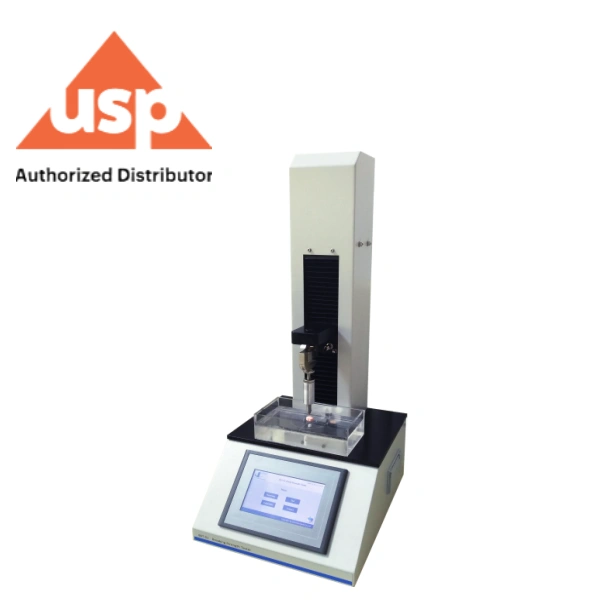
A modern hardness tester machine for tablets applies a controlled compressive load to a tablet placed between two parallel plates. The plates move at a constant speed or apply force at a controlled rate until the tablet fractures. The maximum force recorded at the point of failure is reported as the breaking force, usually in newtons (N).
Compared with early manual devices, modern electronic testers offer significant advantages:
Stable and repeatable loading rates
High-resolution force measurement
Digital data recording and traceability
Reduced operator influence
These features are essential for meeting regulatory expectations and ensuring data comparability across batches, instruments, and testing sites.
Break Test Mechanics and Tablet Orientation
The break test outcome strongly depends on tablet geometry and orientation. For round tablets, diametral compression is typically used, with force applied across the diameter. For scored or capsule-shaped tablets, orientation must be clearly defined to ensure a consistent failure plane.
Tablet orientation also affects data interpretation. A change in the fracture plane, even when breaking force values appear similar, may indicate changes in formulation or compression behavior. Recording orientation and fracture characteristics therefore adds valuable diagnostic insight to routine hardness testing.
Relationship Between Tablet Hardness Test and Friability
Although related, the tablet hardness test and friability of tablet measure different aspects of mechanical behavior. Friability reflects resistance to surface damage during tumbling, while breaking force reflects resistance to internal fracture under compressive load.
A tablet may show acceptable friability but insufficient breaking force, or vice versa. For this reason, USP guidance encourages manufacturers to evaluate both properties during development and establish specifications that reflect real-world performance requirements.
Advanced Interpretation and Tensile Strength Concepts
Breaking force values depend on tablet size and shape. To normalize results, some manufacturers calculate tablet tensile strength using established equations that account for diameter and thickness. While not always required for routine quality control, tensile strength analysis can provide deeper insight during formulation optimization and troubleshooting.
Choosing the Right Testing Solution from Cell Instruments
At Cell Instruments, we design and manufacture advanced hardness tester machines for tablets that support accurate, repeatable, and compliant tablet hardness testing. Our systems integrate precise load control, reliable force sensors, and flexible configurations to meet diverse testing needs across pharmaceutical and medical industries.
With expertise in material testing, automation customization, and pharmaceutical quality evaluation, Cell Instruments helps laboratories implement efficient tablet hardness test programs that align with USP 1217 expectations and modern manufacturing demands.
Conclusion
The tablet hardness test remains a cornerstone of pharmaceutical quality control. Guided by USP 1217, it provides essential insight into tablet breaking force, complements friability testing, and supports consistent product performance. By using reliable testing equipment and interpreting results within the broader context of tablet design, manufacturers can ensure robust, compliant, and patient-ready dosage forms.
 English
  العربية
  Български
  Čeština
  Dansk
Dansk  Deutsch
  Ελληνικά
  Español
  Eesti
Eesti  Suomi
Suomi  Français
  Magyar
  Bahasa Indonesia
  Italiano
  日本語
日本語  한국어
한국어  Lietuvių kalba
  Latviešu valoda
  Norsk bokmål
  Nederlands
  Polski
  Português
  Română
  Русский
  Slovenčina
  Slovenščina
  Svenska
  Türkçe
  Українська