
Understanding Softgel Capsule Hardness Testing Equipment
Softgel Capsule Hardness Testing Equipment is an essential solution for pharmaceutical and nutraceutical manufacturers to evaluate the mechanical strength, deformation behavior, and structural integrity of soft gelatin capsules. Softgels contain liquid, semi-solid, or oil-based formulations, and their gelatin shells must maintain sufficient strength during manufacturing, packaging, transportation, and storage. Accurate hardness testing helps manufacturers prevent capsule leakage, breakage, deformation, and inconsistent product performance.
Unlike traditional visual inspection methods, a professional Capsule Hardness Tester provides quantitative measurements by applying controlled compression or penetration forces to determine how softgels respond to mechanical stress. These results allow quality engineers, R&D teams, and production managers to optimize gelatin formulations, production processes, and packaging conditions.
The CHT-01 Capsule and Softgel Hardness Tester is designed as a modern Softgel Hardness Testing System for evaluating softgels, hard capsules, and other pharmaceutical dosage forms. It measures key mechanical properties including rupture strength, hardness, and deformation characteristics to support pharmaceutical quality control and formulation development.
Why Softgel Hardness Testing Is Important
Soft gelatin capsules are widely used for vitamins, dietary supplements, pharmaceutical drugs, and nutraceutical products because they provide excellent bioavailability and consumer convenience. However, the gelatin shell is sensitive to formulation composition, moisture conditions, plasticizer ratio, drying processes, and storage environments.
Insufficient shell strength may cause:
- Leakage of liquid fillings
- Capsule deformation during handling
- Seal failure during packaging
- Reduced shelf stability
- Product rejection during quality inspection
Excessive hardness may also create problems, such as poor dissolution performance or difficulties during manufacturing and consumption.
By using Softgel Testing equipment, manufacturers can establish measurable quality criteria instead of relying on subjective evaluation. Mechanical testing data provides valuable information for:
- Incoming material inspection
- Gelatin formulation optimization
- Production process control
- Stability studies
- Packaging evaluation
- Regulatory documentation
Testing Principles of Softgel Capsule Hardness Measurement
A Softgel Hardness Testing System evaluates the mechanical response of a capsule when a controlled force or displacement is applied. During testing, the instrument records force, distance, and deformation data to characterize the strength and flexibility of the capsule shell.
The main testing methods include:
Peak Test (Rupture Strength Test)
The Peak Test measures the maximum force required to penetrate or rupture a softgel capsule. This method evaluates the resistance of the gelatin shell against external impact or compression.
Important parameters include:
- Peak force: Maximum force before rupture
- Rupture behavior: The point where the shell fails
- Shell consistency: Variation between individual capsules
This test is particularly useful for identifying weak seals or fragile gelatin films that may fail during transportation or packaging.
Distance Test (Hardness or Deformation Test)
The Distance Test measures the force required to compress a capsule to a predefined deformation distance. A common evaluation method uses a fixed displacement, such as 2 mm deformation, to calculate capsule hardness.
This test helps determine:
- Shell elasticity
- Resistance to deformation
- Mechanical consistency between batches
Weight Test (Custom Load Analysis)
The Weight Test applies a user-defined compression force and evaluates capsule deformation behavior under controlled loading conditions. It is useful for research applications where manufacturers need to understand how softgels respond to different mechanical stresses.
Materials and Applications of Softgel Testing
Materials
The application range of a Capsule Hardness Tester extends beyond standard pharmaceutical softgels. It can evaluate different capsule materials and dosage forms used in pharmaceutical and healthcare industries.
| Material / Sample | Typical Applications |
|---|---|
| Soft gelatin capsules | Vitamins, fish oil, omega supplements, pharmaceutical softgels |
| Hard capsules | Oral solid dosage products and formulation development |
| Gelatin shells | Evaluation of gelatin strength and formulation optimization |
| Nutraceutical capsules | Dietary supplement quality control |
| Customized capsule samples | R&D studies and special dosage form evaluation |
Applications
Pharmaceutical Manufacturing Quality Control
Pharmaceutical manufacturers use Softgel Capsule Hardness Testing Equipment to verify capsule consistency throughout production. By measuring mechanical properties, manufacturers can identify variations caused by gelatin composition, filling process changes, or environmental conditions.
Hardness testing supports:
- Batch-to-batch consistency evaluation
- Process validation
- Quality release testing
- Failure investigation
Softgel Formulation Development
During R&D, formulation engineers need reliable mechanical data to optimize gelatin formulations. Changes in gelatin type, plasticizer concentration, moisture content, and additives can significantly affect capsule strength.
A Softgel Hardness Testing System provides rapid feedback during formulation trials, helping researchers select suitable materials and processing parameters.
Packaging and Transportation Simulation
Softgels experience mechanical forces during filling, packaging, shipping, and storage. Compression and rupture testing help evaluate whether capsules can withstand these conditions without leakage or damage.
Key Features of CHT-01 Capsule and Softgel Hardness Tester
The CHT-01 is designed for laboratories requiring accurate and repeatable softgel mechanical testing.
Key advantages include:
- Controlled force and displacement testing
- High accuracy measurement system
- Adjustable testing speed
- Automatic data recording
- Customizable fixtures for different capsule sizes
- Compliance support for regulated pharmaceutical environments
The instrument uses a precision ball screw and stepper motor system to ensure stable movement and repeatable test results. The adjustable speed range allows users to simulate different testing conditions for research and quality control purposes.
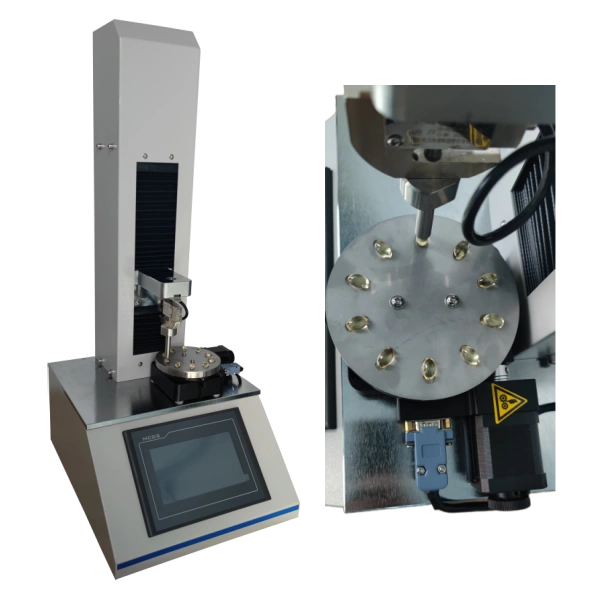
Technical Specifications
| Parameter | Specification |
|---|---|
| Test Range | 0–200 N (customizable according to requirements) |
| Stroke | 200 mm (without clamp) |
| Test Speed | 1–300 mm/min (adjustable) |
| Displacement Accuracy | 0.01 mm |
| Accuracy | ±0.5% F.S. |
| Display | 7-inch HMI touchscreen |
| Data Output | Screen, microprinter, RS232 optional |
| Control System | PLC control |
| Power Supply | AC 110–220 V, 50/60 Hz |
Advanced Features for Pharmaceutical Quality Control
The CHT-01 supports modern laboratory requirements through intelligent control and flexible configuration.
Customized Testing Solutions
Different capsule sizes and shapes may require customized fixtures. The CHT-01 supports optional configurations including:
- Multi-station rotary testing systems
- Custom probes
- Special fixtures for unique dosage forms
- Software upgrades
GMP and Data Integrity Support
For regulated pharmaceutical environments, the system supports:
- User access level management
- Test data retrieval
- Electronic data management options
These functions help laboratories improve traceability and maintain reliable testing records.
Intelligent Operation
The 7-inch touchscreen interface provides:
- Real-time test curve display
- Test parameter setup
- Data storage and retrieval
- Statistical analysis functions
Choosing the Right Capsule Hardness Tester
When selecting a Capsule Hardness Tester, laboratories should consider:
- Sample Type
The equipment should accommodate different capsule sizes, shapes, and formulations. - Testing Requirements
Different applications may require rupture testing, deformation testing, or compression analysis. - Accuracy and Repeatability
Pharmaceutical quality control requires stable measurement performance. - Data Management Requirements
For regulated environments, data recording and traceability functions are important. - Customization Capability
Special applications may require customized fixtures or testing methods.
A professional Softgel Capsule Hardness Testing Equipment solution helps manufacturers achieve reliable quality evaluation while supporting product development and regulatory compliance.
Conclusion
Softgel Capsule Hardness Testing Equipment is designed to measure the mechanical properties of soft gelatin capsules, including rupture strength, hardness, and deformation resistance. By applying controlled compression or penetration forces, the equipment provides accurate data for pharmaceutical and nutraceutical manufacturers to evaluate capsule integrity, optimize formulations, and improve quality control. The testing system supports applications such as softgel production inspection, formulation development, stability studies, and packaging performance evaluation.
Reliable softgel mechanical testing helps pharmaceutical manufacturers improve product consistency, prevent capsule failures, and maintain quality throughout the product lifecycle. Cell Instruments provides professional capsule testing solutions with customizable fixtures, accurate measurement systems, and flexible configurations for different softgel applications. Whether for routine quality control, R&D testing, or specialized pharmaceutical evaluation, our Softgel Capsule Hardness Testing Equipment can help laboratories achieve repeatable and trustworthy testing results. Contact us to learn more about suitable testing solutions for your applications.
 English
  العربية
  Български
  Čeština
  Dansk
Dansk  Deutsch
  Ελληνικά
  Español
  Eesti
Eesti  Suomi
Suomi  Français
  Magyar
  Bahasa Indonesia
  Italiano
  日本語
日本語  한국어
한국어  Lietuvių kalba
  Latviešu valoda
  Norsk bokmål
  Nederlands
  Polski
  Português
  Română
  Русский
  Slovenčina
  Slovenščina
  Svenska
  Türkçe
  Українська
  עִבְרִית
  ไทย
ไทย  Tiếng Việt